
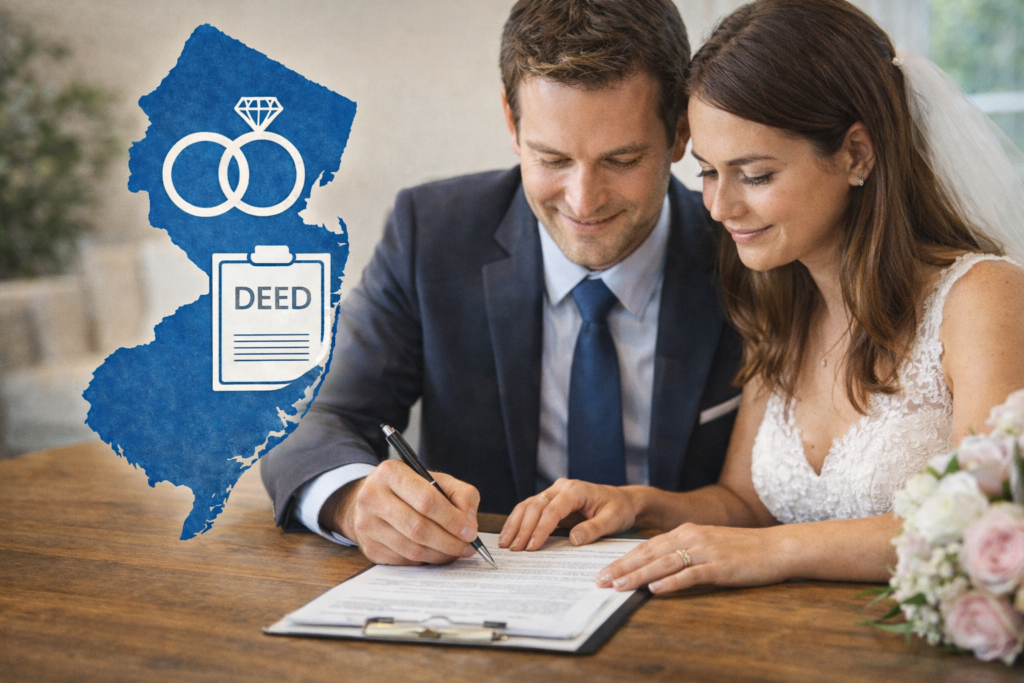
Are you seeking to add a spouse to a deed in New Jersey?
New Jersey law allows you to add your spouse to a deed. Married couples by default hold the property after the spouse joins the title as “tenants by entirety” meaning ownership automatically passes to the other upon death and neither party may change property rights without consent
The process to add your spouse to the deed should begin with hiring a real estate attorney. The attorney will review title, select the right co-ownership, and prepare the new deed with all required tax forms. Next, you sign the deed before a notary, and the attorney records it with the county clerk.
Call our law firm today at (201) 627-2457 or use the contact form for assisting with updating a deed.
Can I add my spouse to a New Jersey deed?

Yes. You can add your spouse to a New Jersey deed by signing and recording a new deed that transfers the property from you alone to you and your spouse together.
Married couples normally hold title on the new deed as tenants by the entirety. Only married couples (and by extension civil union partners) are eligible for this form of ownership.
Tenants by the entirety has the following features:
- Unity and Indivisibility. Each spouse is deemed to own the whole property. By statute, neither spouse may sever, alienate, or otherwise affect their interest in a tenancy by the entirety during the marriage or upon separation without the written consent of both spouses (N.J.S. § 46:3-17.4). As a result, one spouse cannot unilaterally sell, mortgage, or otherwise encumber the property, and cannot force a partition or sale during the marriage.
- Survivorship. A key feature of tenancy by the entirety is the right of survivorship: upon the death of one spouse, the surviving spouse automatically acquires full ownership of the property, outside of probate.
- Creditor Rights. Creditors of one spouse may reach that spouse’s interest in the property, but only in a limited way. A creditor can levy on the debtor-spouse’s right of survivorship and their undivided interest during the joint lives, but cannot force partition or sale during the marriage. The creditor’s rights remain subject to the non-debtor spouse’s survivorship interest; if the non-debtor spouse outlives the debtor spouse, the creditor’s interest is extinguished.
- Termination and Conversion upon Divorce. Divorce automatically converts a tenancy by the entirety into a tenancy in common. After conversion, each former spouse owns an undivided share that can be partitioned, and creditors may reach that share.
Unless the deed states otherwise, tenancy by the entirety is assumed. See N.J.S. § 46:3-17.3 (“No instrument creating a property interest on the part of a husband and wife shall be construed to create a tenancy in common or a joint tenancy unless it is expressed therein”).
Section 2: How do I add my spouse to a deed?

Step 1: Work with a New Jersey real estate attorney
Preparing deeds for others is considered the practice of law in New Jersey. Although an owner can prepare a deed on their own behalf, no other parties may prepare a deed with few exceptions. See New Jersey State Bar Ass’n v. Northern New Jersey Mortg. Associates, 161 A.2d 257, 32 N.J. 430 (N.J. 1960) (“I agree with the majority that there is no such thing as a simple legal instrument in the hands of a layman. A layman is not competent to determine whether a quitclaim deed, a warranty deed or a bargain and sale deed should be used in a particular case.”)
The following are types of issues that are more likely to occur without qualified counsel:
- Incorrect Legal Description: Legal description may be incomplete or inaccurate. This can result in disputes over boundaries, result in the deed being rejected, or being recorded on the wrong property.
- Failure to Identify Parties Properly: The names of the grantor (seller) or grantee (buyer) may be misspelled, incomplete, or not match other legal documents.
- Improper Execution or Acknowledgment: The deed may not be properly signed, witnessed, or notarized as required by New Jersey law.
- Omission of Required Language: Certain statutory language or clauses (such as warranties, covenants, or “subject to” clauses) may be omitted, which can affect the rights and obligations of the parties.
- Tax Consequences: Errors in the deed may trigger unintended tax liabilities, such as transfer taxes or capital gains taxes, or may fail to take advantage of available exemptions.
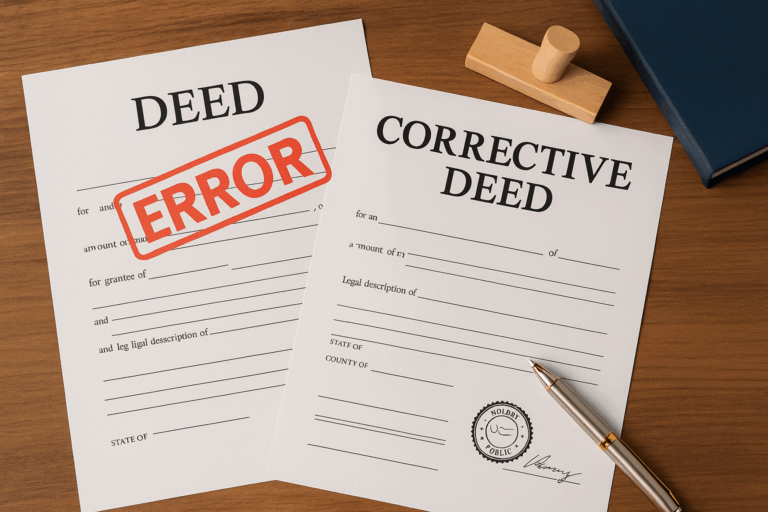
- Failure to Deliver or Record the Deed: The deed may not be properly delivered to the grantee or recorded with the appropriate county office,
- Ambiguity in Joint Ownership: If the deed does not clearly specify the type of joint ownership (e.g., joint tenancy, tenancy in common, tenancy by the entirety), it can lead to confusion about survivorship rights and inheritance.
Step 2: Prepare the Deed and Tax Forms
A real estate deed must contain several key elements to be effective, including the names of the grantor and grantee; a statement of consideration for the transfer, often expressed as “for $1 and other valuable consideration”; and a legal description of the property sufficient to identify its exact location and boundaries.
The deed must also include a granting clause clearly expressing the grantor’s intent to convey ownership.
When adding your spouse to the deed, the following language is typically used:
John Smith, whose address is [address], single, Grantor; and “John Smith and Jane Smith, husband and wife, whose address is [address], Grantee.
Besides the deed itself, other forms needed are:
GIT/REP-3 – Seller’s Residency Certification. A GIT/REP-3 form is a New Jersey Division of Taxation document required to certify the seller’s residency status and to report and pay any required estimated New Jersey gross income tax on gains from the sale. The form must be submitted to the county recording officer with the deed, and the deed cannot be recorded unless the GIT/REP-3 is filed and any required tax is paid or an applicable exemption is properly certified.
RTF-1 – Affidavit of Consideration. An RTF Affidavit of Consideration is a sworn, notarized statement disclosing the true consideration (purchase price or value) paid for a property and the basis for any claimed exemption from the Realty Transfer Fee or the applicability of related transfer taxes. This forms help claim exemptions from the New Jersey realty transfer fee for deeds between spouses and nominal-consideration transfers.
Step 3: Sign and notarize the deed
New Jersey requires deeds to be acknowledged before a notary, attorney, or other authorized officer under N.J.S.A. 46:14-6.1.
The notary verifies your identity and attaches a proper acknowledgment block.
Typically, notarization is done in person. However, you can notarize remotely in New Jersey if requirements are followed. The notary must verify identity and use approved communication technology. See N.J.S.A. 52:7-10.10.
Step 4: Record the deed with the county clerk
Deeds adding a spouse in New Jersey must be recorded in the county records to place the public on notice of the change. To be recorded, deeds must include the grantee’s mailing address, preparer’s name, and lot and block number. Recording occurs with the county clerk or registrar (for example Essex, Bergen, Passaic, Hudson).
New Jersey follows a “race-notice” system. The first properly recorded deed takes priority. See N.J.S.A. 46:26A-12; Cox v. RKA Corp., 164 N.J. 487 (2000) (“New Jersey is considered a race notice jurisdiction, which means that as between two competing parties the interest of the party who first records the instrument will prevail so long as that party had no actual knowledge of the other party’s previously-acquired interest.”)
After recording, you should: (i) update your homeowners insurance so your spouse is an insured owner; (ii) confirm that the tax assessor and municipality updates their records.
Section 3: Legal Considerations

Creditor and judgment issues
Although adding your spouse to the deed offers benefits, you must carefully consider the potential creditor and judgment risks. When only one person holds title and that person has strong credit and no legal issues, the risk of judgments attaching to the property is generally low.
However, if you add a spouse who has a history of poor credit, unpaid debts, or legal problems, doing so can create significant exposure. Once your spouse becomes an owner, any court judgments entered against them attach as liens against the property. While a lender may be limited in foreclosing against property held as tenants by the entirety, the will still need to be resolved if you refinance or sell the property.
Estate Planning
Before transferring a deed, you should carefully evaluate how the change will affect your overall estate plan.
Deed transfers operate independently of a will, and adding a spouse to title can unintentionally override existing estate planning documents. For example, you may have a will or trust that leaves the property to a child, other family member, or a third party. If you later add your spouse to the deed as husband and wife—particularly as tenants by the entirety—the property will pass automatically to your spouse upon your death by operation of law, regardless of what your will provides.
This can create a direct conflict with your intended distribution plan and may frustrate your broader estate planning goals. Adding a spouse to title should be coordinated with an estate planning attorney to ensure all documents align.
Loss of Control
Once you add your spouse to the deed, you lose the unilateral ability to sell, refinance, mortgage, or transfer the property without your spouse’s consent and signature. Even if you originally purchased and paid for the property yourself, joint ownership gives your spouse express legal ownership.
This is particularly important to consider for investment properties or properties intended to remain under one person’s control.
Section 4: FAQ
Can I add my spouse to deed after closing?
Yes. You can add your spouse to the deed at any time after closing by signing and recording a new deed, even years later. The timing does not change the basic requirements: a valid written deed, proper execution, delivery, and recording in the county where the property sits.
The main factor is your current legal situation. Your attorney will check for existing liens, judgments, or pending litigation before changing title so you do not inadvertently worsen a creditor problem or upset an existing divorce or estate plan.
Can I add my spouse to deed after marriage?
Yes. Many people wait until after the wedding to ask “how to add spouse to deed” or update title. From a legal standpoint, the key is that you are married by the time you sign the deed, so tenancy by the entirety can arise by statute.
If you bought the home before marriage in your name alone, you still have the option to transfer it from yourself to yourself and your spouse as husband and wife. That is a common way to align your title with your new marital status and long-term plans.
Can I add my spouse to a deed but not mortgage?
Usually, yes. The deed and the promissory note are separate documents, so you can transfer ownership without changing who owes the loan. Many spouses add a partner to the deed yet remain the only borrower on the mortgage.
However, you must still check your loan documents and speak with your lender. Some lenders require consent or additional paperwork, especially where the transfer might affect underwriting, escrow, or insurance arrangements.
Should I use a quitclaim deed?
Quitclaim deeds are simple and widely used between family members. They are common in divorces, where one spouse conveys their interest to the other, and also in simple “how to add spouse to deed after marriage” scenarios.
The trade-off is that a quitclaim deed gives no warranties about title quality. If you have a more complex title history, a bargain and sale deed with covenant may give your spouse a modest extra layer of protection while still keeping the process streamlined.
How much does it cost to add spouse to a deed?
Costs vary, but you should expect:
- Attorney fees for deed preparation and consultation.
- Recording fees and small surcharges charged by the county clerk.
- Possible realty transfer fee, if no exemption applies.
In routine spousal transfers, realty transfer fee exemptions often apply, and costs stay relatively modest compared to a full sale closing. Your attorney can give a realistic estimate once they see your current deed, county, and lender documentation.
Contact the Law Firm of Earl P. White
Contact us today for help with adding your spouse to a deed in New Jersey. We provide practical advice, responsive service, and clear direction to address the issue efficiently and protect your interests.
📞 Call Us: (201) 627-2457
💬 Send a Message: Use our contact form and we will follow-up.
We look forward to assisting you with your real estate needs.
Featured Content
Transferring Ownership With an Open Mortgage in New Jersey
Can you transfer a New Jersey property with an open mortgage? Learn the risks, due-on-sale rules, federal exceptions, and how deed transfers really work.