

Do you need an attorney for an eviction in New Jersey?
An attorney is a legal requirement for filing an eviction in New Jersey for properties owned by entity, such as a limited liability company or corporation. Eviction actions for real estate owned by a person do not require an attorney.
However, eviction is never as simple as serving a notice, showing up at court, and the tenant vacating. New Jersey’s Anti-Eviction Act has strict tenant-protection. Honest mistakes can result in dismissal, restarts, and in turn lost cash flow or on-going damage to the premises.
This blog explains when a landlord needs an attorney, how court rules apply to individuals and companies, and why professional representation reduces risk, cost, and delay.
Call our law firm today at (201) 627-2457 or use the contact form to begin evicting your tenant.

Is an Eviction Attorney Needed to File an Eviction Case?
Whether an attorney is necessary to file an eviction case depends on whether the owner of the property is an individual or a company.
For regular individuals, no – an attorney is not required.
New Jersey allows natural persons and sole proprietors to file and prosecute their own eviction cases.
An individual landlord may appear pro se because they are representing only themselves (not another legal entity). Small landlords are permitted manage evictions without legal fees.
For companies, yes – New Jersey law requires the use of an attorney.
New Jersey law is stricter for LLCs, corporations, partnerships, and any entity that is not a sole proprietorship.
Under Rule 1:21-1(c) of the New Jersey Court Rules:
(c) Prohibition on Entities . . . an entity, however formed and for whatever purpose, other than a sole proprietorship shall neither appear nor file any paper in any action in any court of this State except through an attorney authorized to practice in this State.
The Appellate Division has repeatedly affirmed this requirement.
See ABL One, LLC v. 159 Pierson, LLC, APPELLATE DIVISION DOCKET NO. A-2452-18T3 (October 2019) (“In accordance with Rule 1:21-1(c), corporate entities must be represented in court by an attorney and shall neither appear nor file any paper in any action in any court of this State except through an attorney authorized to practice in this State. See also Pressler & Verniero, Current N.J. Court Rules,on R. 1:21-1(c) (2019).”)
Kornegay Construction LLC v. University Heights Condominium Association, APPELLATE DIVISION DOCKET NO. A-1006-17T4 (April 2019) also confirmed a business entity cannot appear in court without a licensed attorney, even in the Special Civil Part.
The Appellate Division explained that “Rule 1:21-1(c)… makes clear that any entity, regardless of its purpose or organization, must be represented in court by an attorney,” and reversed a judgment that had been entered after a non-lawyer tried to represent an LLC at trial. This decision reinforces that LLC landlords must hire counsel to file or defend an eviction, and any attempt to proceed without an attorney risks dismissal or having the judgment vacated.
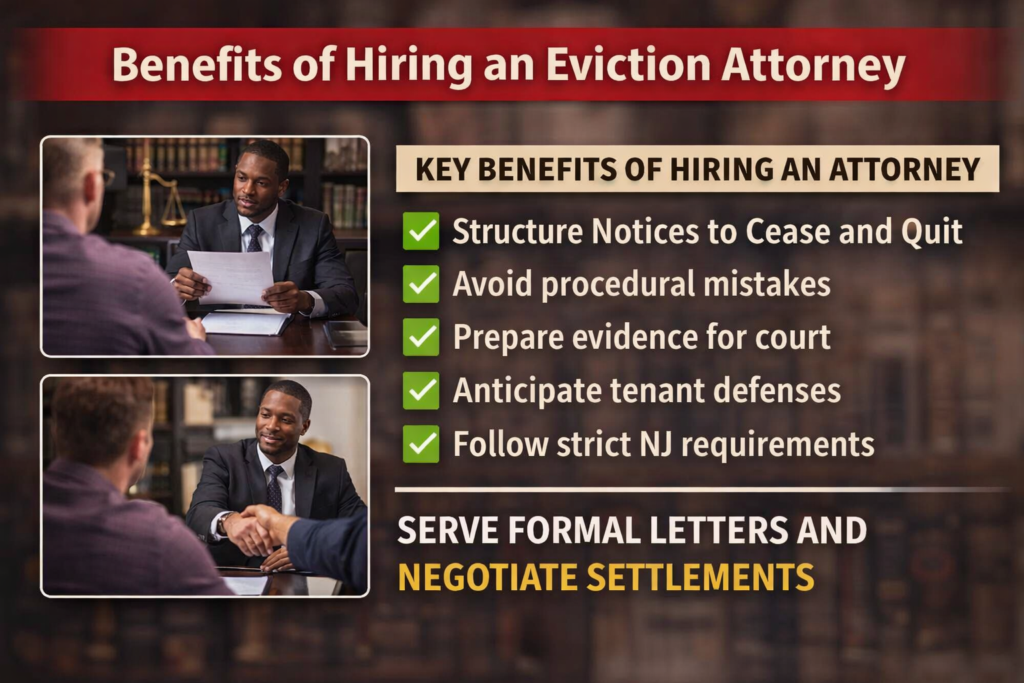
Benefits of Hiring an Eviction Attorney
The better question is not whether an attorney is required – but whether an attorney is beneficial to winning your eviction case.
Key benefits of hiring an attorney
An eviction lawyer provides more than courtroom representation. They help landlords:
- Structure compliant Notices to Cease and Notices to Quit
- Avoid procedural mistakes that delay cases
- Prepare evidence and anticipate tenant defenses
- Navigate New Jersey’s strict Anti-Eviction Act requirements
- Follow correct filing, service, and proof standards
- Reduce exposure to claims of wrongful eviction
These protections matter because tenants may raise habitability, retaliation, discrimination, or payment-related defenses. An attorney prepares landlords for these issues before they derail the case.
Serving a formal letter may prevent the need for eviction.
Tenants respond more seriously when a lawyer becomes involved.
A formal attorney letter demanding compliance or payment often persuades tenants to cure violations or negotiate a voluntary move-out to prevent the need for litigation. Early intervention saves time, money, and the stress of a court appearance.
Attorneys can negotiate enforceable settlements.
Evictions often resolve through consent judgments or settlement agreements that bind the tenant to vacate by a specific date.
These agreements include “judgment triggers,” meaning if the tenant fails to move by the agreed-upon date, the landlord can apply for removal without a contested hearing.
These settlements help landlords avoid trial uncertainty and protect their rights with enforceable terms. Without legal guidance, landlords may attempt informal side agreements are difficult to enforce.
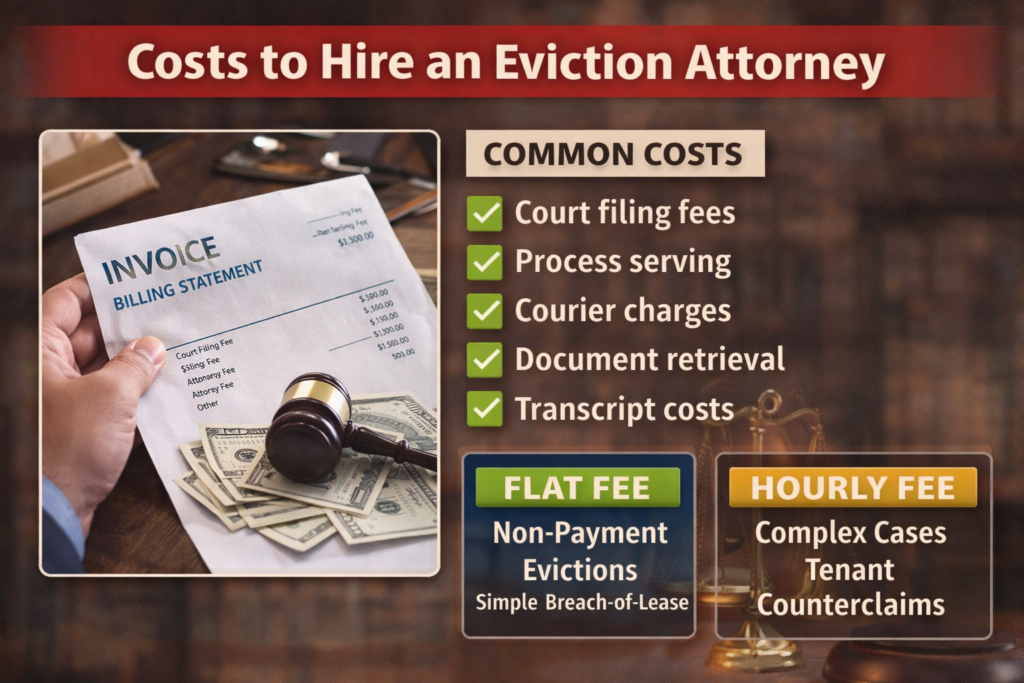
Costs to Hire an Eviction Attorney
The cost of hiring an eviction attorney varies widely.
Fee models differ among attorneys.
Attorneys often offer a flat fee for non-payment eviction or simple breach-of-lease cases.
The flat fee usually covers preparing the and filing complaint, attending one court hearing, and coordinating with the tenant. Other attorneys use hourly billing, especially for complex cases involving repeated violations, tenant counterclaims, or multiple court appearances.
The right legal fee arrangement depends on case complexity, landlord’s comfort with potential additional costs, and attorney and client preference.
Clients typically cover filing fees and administrative costs.
Regardless of the billing model, landlords are traditionally responsible for:
- Court filing fees
- Service-of-process costs
- Shipping or courier charges
- Document-retrieval fees
- Any required transcript or enforcement costs
These expenses are standard and separate from attorney fees. Most administrative expenses apply even if a landlord proceeds without counsel.
Contact the Law Firm of Earl P. White
Contact us today for help with a landlord-tenant or real estate matter. We provide practical advice, responsive service, and clear direction to address the issue efficiently and protect your interests.
📞 Call Us: (201) 627-2457
💬 Send a Message: Use our contact form and we will follow-up.
We look forward to assisting you with your landlord-tenant and real estate needs.

Stay ahead with our free newsletter: The Real Estate Law Newsletter – your source for real estate law news.
Essential updates and insights direct to you. Impress clients and colleagues with trending news. Sharpen expertise. Stay legally compliant. Access free legal forms. Don’t miss out – join today!