Do you need to send a Section 8 tenant a notice in New Jersey?
Whether you are addressing a lease violation, documenting rent issues, or taking the first step towards eviction, the correct notice is critical to stay compliant with New Jersey and federal law.
Landlords commonly use Notices to Cease, Notices to Quit, and rent-related notices. The type and timing of the notice depend on the reason for the notice. A valid Section 8 notice should clearly state the issue, cite the lease or legal basis, and be served properly on the tenant and the Public Housing Authority. Generic templates typically don’t succeed.
This guide is for New Jersey landlords and property managers who rent to Section 8 voucher holders and want to serve compliant notices without risking delay or eviction dismissal.
Call (201) 627-2457 or visit our Contact Us page today for help with drafting, serving, or enforcing a tenant notice and eviction.
Notices Landlords Use
There is no “universal” Section 8 tenant notice form in New Jersey that fits every situation. The key is not generic notice templates but executing the right type of notice, for the right grounds, at the right time.
Notice to Cease
A Notice to Cease is a written warning from the landlord to the tenant demanding the tenant stop specific conduct, such as violating the lease or rules, disorderly behavior, or habitually late payments.
In New Jersey, the Notice to Cease must be served before filing most “for-cause” evictions. The Notice to Cease becomes a “paper trail” showing the tenant was clearly advised of and had an opportunity to stop the conduct at issue.
You most commonly use a Notice to Cease when the eviction is under the New Jersey Anti-Eviction Act based on ongoing or repeatable behavior, such as:
- Disorderly conduct / disturbing the peace (often used before termination when the issue is repeated noise, harassment, nuisance-type conduct) (N.J.S.A. 2A:18-61.1(b)).
- Violation of landlord’s rules and regulations (the rules must be reasonable and properly adopted/served) (N.J.S.A. 2A:18-61.1(d)).
- Violation of the lease (non-monetary lease breaches like unauthorized occupants, pets, smoking, improper use of premises, etc.) (N.J.S.A. 2A:18-61.1(e)).
- Habitual late payment of rent (pattern of repeated late payments, even if rent is eventually paid) (N.J.S.A. 2A:18-61.1(j)).
For a Section 8 tenant, the Notice to Cease supports your claim of serious or repeated lease violations – a requirement for many evictions under federal law. See 24 C.F.R. § 982.310(a)(1).
Notice to Quit (Termination Notice)
A Notice to Quit is the formal termination notice that ends the tenancy and demands possession of the rental unit after a legally required waiting period. Without a valid Notice to Quit (when required), the eviction case is unlikely to be successful.
Under the New Jersey Anti-Eviction Act, a Notice to Quit is required for reasons for eviction other than nonpayment of rent. The statute sets different notice periods depending on the reason for termination, such as three days, one month, or two months. See N.J.S.A. 2A:18-61.2.
A proper Notice to Quit must clearly identify the statutory ground for eviction, describe the facts supporting that ground, and state the specific date on which the tenancy will terminate. In cases involving ongoing behavior (such as disorderly conduct, lease violations, or habitual late payment), the Notice to Quit must typically be preceded by a Notice to Cease, giving the tenant an opportunity to correct the conduct before termination.
Notice to Vacate
A Notice to Vacate is a notice landlords use to inform a tenant that the landlord expects the unit to be vacated by a certain date.
In New Jersey, a “Notice to Vacate” is not a defined notice under the Anti-Eviction Act and does not satisfy the statutory notice requirements needed to file an eviction case. Because a notice to vacate lacks statutory authority, landlords should not rely on documents titled “notice to vacate” in tenant disputes.
Demand to Pay Rent
A Demand to Pay Rent, sometimes called a rent arrears letter, is a written notice advising the tenant rent is overdue and stating the amount claimed.
A Demand to Pay Rent is not necessary for evictions in New Jersey. Landlords may opt to use a rent demand letter as a tool to receive owed rent without court intervention – particularly in Section 8 cases where rent is paid by the government and tenant.
Rent demands can help build an eviction case by creating a record showing when the tenant fell behind, how much was owed at the time of the notice, and that the landlord made a good-faith effort to resolve the case before appearing in court.
Notice Requirements
New Jersey and federal law impose detailed notice requirements before a Section 8 tenancy can be terminated.
Strict Compliance Required
New Jersey requires “strict compliance” with all eviction notice requirements. Even if the landlord acted with good faith and the tenant was not harmed, the court will not accept “substantial compliance”.
A defective notice can void your case. If you’re unsure whether your notice complies, call (201) 627-2457 or visit our Contact Us page today.
See J. Allen Nimmo Apartments v. Martinez, A-1337-23 (N.J. Super. App. Div. Nov 21, 2024) (“Strict compliance with the Act, including all notice provisions, traditionally has been a jurisdictional prerequisite for a dispossession action.”); Vander Sterre Bros. Const. v. Keating, 665 A.2d 779 (N.J. Super. App. Div. 1995) (“we refused to find substantial compliance met the strict-compliance standard”)
New Jersey Notice Rules
The New Jersey Anti-Eviction Act for residential tenants, except for 1-2 unit owner-occupied properties, sets forth the required timing and types of notices.
- Nonpayment of rent: A Notice to Quit is not required before filing for nonpayment eviction.
- Disorderly conduct / disturbing the peace: Notice to Cease first, then a 3-day Notice to Quit before filing.
- Willful or grossly negligent damage/destruction: 3-day Notice to Quit before filing.
- Substantial violation of rules/regulations: Notice to Cease first, and then (if it continues) a 1-month Notice to Quit.
- Substantial breach of lease covenants: Notice to Cease first, and then (if it continues) a 1-month Notice to Quit.
- Habitual late payment of rent: Notice to Cease first, and then a 1-month Notice to Quit.
- Owner occupancy/buyer occupancy in 3 or fewer unit buildings: 2-month Notice to Quit.
Notices to Quit must “state the reason for termination, the parties’ names and relationship as landlord and tenant, the date that the premises must be vacated, and the date that the right to possession terminates.” Ktwe Grp. v. Balaj, A-0273-24 (N.J. Super. App. Div. Sep 18, 2025).
Notices to Cease must “specify in detail the cause of the termination of the tenancy, requiring a landlord to name in a specific or explicit manner the grounds for eviction. Such specificity in an eviction action is required to allow tenants an adequate opportunity to prepare a defense before trial and satisfy a tenant’s right to know as much as possible about any eviction proceeding brought against him or her.” J. Allen Nimmo Apartments v. Martinez, A-1337-23 (N.J. Super. App. Div. Nov 21, 2024).
“Section 8″ Notice Rules
Federal rules add a second layer of requirements for evicting Section 8.
An owner may only terminate a tenancy following these protocols under 24 C.F.R. § 982.310 and 24 C.F.R. § 247.4:
Content of Notices
- Termination must be based only on permitted grounds (serious or repeated lease violations, criminal activity, violation of law related to occupancy, or other good cause).
- The notice must be in writing.
- It must state the specific date the tenancy will terminate.
- It must state the reasons for termination with enough factual detail to allow the tenant to prepare a defense.
- It must advise the tenant that if they remain in the unit after the termination date, the landlord may enforce the termination only through a court action.
- It must inform the tenant that they will have the opportunity to present defenses in court.
- The required notice period is generally at least 30 days for most terminations (unless a shorter period is permitted for serious lease violations or criminal activity), and may be longer if required by state law or the lease.
Delivery Requirements (How and When the Notice Must Be Given)
- The written notice must be given at or before the commencement of any eviction action.
- The notice may be combined with any state or local eviction notice (such as a Notice to Quit).
- The landlord must provide the Public Housing Authority (PHA) with a copy of any eviction notice given to the tenant.
- The owner may only evict by filing and pursuing a judicial action; self-help is prohibited.
- Federal regulations require service by both first-class mail and delivery to the unit (or by affixing the notice to the door if no one answers).
- Service is not effective until both required methods of delivery are completed.
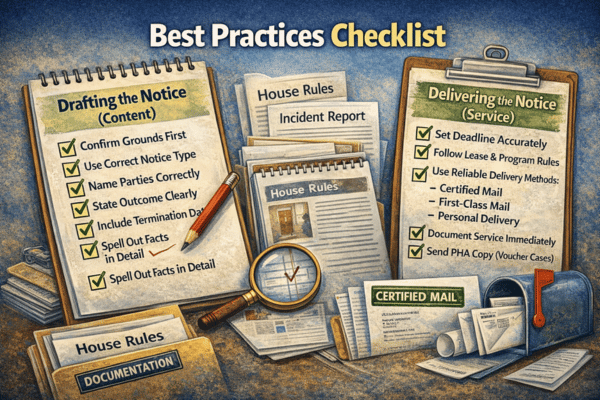
Best Practices Checklist
Checklist: Drafting the Notice (Content)
- Confirm the correct ground first (state “good cause” ground, and if a Section 8 voucher, confirm the federal termination basis).
- Use the correct notice type (Notice to Cease vs. Notice to Quit/termination notice; don’t substitute one for the other).
- Name parties correctly (all adult tenants on the lease; correct landlord entity name; correct property address and unit).
- State the requested outcome plainly (cease the conduct; cure the breach; pay the tenant portion; or vacate by the termination date).
- Include a clear termination date when required (don’t leave dates vague; avoid “immediately” or “ASAP”).
- Spell out the facts with “court-ready” detail:
- dates, times, and locations
- what happened and who was involved
- which lease clause/rule was violated
- how many prior incidents (if pattern-based)
- Separate tenant rent from subsidy (in voucher cases, identify the tenant portion arrears distinctly from the PHA payment).
- Avoid overreach or extra accusations (include what you can prove; don’t add inflammatory statements that distract from the ground).
- Attach or reference supporting documents when helpful (house rules, prior Notices to Cease, ledger, photos, incident logs).
- Cross-check compliance items (VAWA protections, fair housing concerns, retaliation issues, reasonable accommodation requests).
Checklist: Delivering the Notice (Service)
- Calendar the deadline first (count the days correctly and build in buffer time).
- Follow the lease and program rules for service (service method can be outcome-determinative in subsidized tenancies).
- Use reliable delivery methods that create proof:
- certified mail/return receipt (when appropriate)
- regular first-class mail
- personal delivery to the unit/posting where permitted
- Document service immediately:
- keep copies of everything served
- keep postal receipts, tracking, photos of posting, and a service log
- note who served it, when, and how
- Serve the PHA when required (voucher cases: send the PHA a copy of the eviction/termination notice; treat this as mandatory even if the tenant is unresponsive).
- Use the same-day rule as a best practice (send tenant + PHA copies the same day to avoid timing disputes).
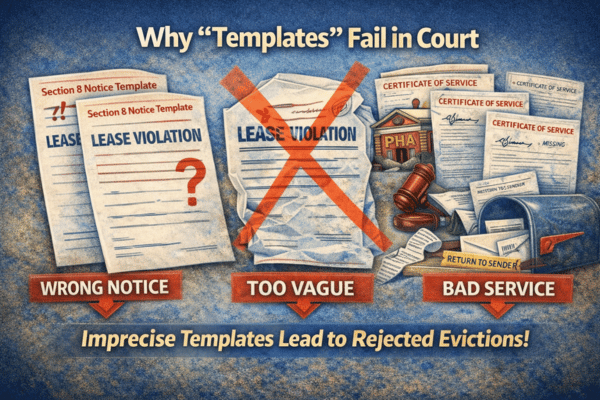
Why “Templates” Fail in Court
Section 8 tenant notice templates feel fast and easy.
However, New Jersey and federal law require precision. General templates lack the specificity to set up a successful eviction case.
Common errors include:
- Wrong Notice for the Legal Ground. Templates often don’t track the exact subsection of the Anti-Eviction Act or the required sequence (e.g., Notice to Cease first, then Notice to Quit).
- Vague or Conclusory Allegation. General notices that say “lease violation” or “disruptive behavior” without dates, specific conduct, lease clauses, and/or warn of the consequences of continued behavior will be found defective.
- Failure to Notify the PHA. In Section 8 cases, landlords generally must provide the Public Housing Authority with a copy of the eviction notice. Templates that ignore PHA notice requirements create jurisdictional problems.
- Improper or Unprovable Service. Missing certificates of service, failing to serve all adult leaseholders, or poor documentation of delivery can sink the case.
Contact the Law Firm of Earl P. White
If you are a landlord, contact us today for assistance with matters related to New Jersey landlord-tenant law and Section 8 compliance. We look forward to hearing from you.
📞 Call Us: (201) 627-2457 💬 Send a Message: Use the contact form, and we will follow up.
Featured Content
3 Key Lease Provisions for Commercial Tenants in New Jersey
Negotiating a commercial lease in New Jersey? Learn the 3 key provisions every tenant must protect: exclusivity, renewal options, and cure periods.How to Evict a Commercial Tenant in New Jersey
Learn how to evict a commercial tenant in New Jersey: notices, timing and costs, reasons, filing, hearings, removal, and lockout steps.Do You Need an Attorney for a Deed Transfer in New Jersey?
Need a deed transfer in New Jersey? Learn if you need a real estate attorney, what forms are required, and how to avoid costly legal mistakes.