
Do you need to evict a commercial tenant in New Jersey?
Landlords can evict a commercial tenant in New Jersey. You may need to first serve a notice to quit or other written notice before filing the case. Once the landlord proves grounds to evict the business tenant, the court enters a judgment for possession. The landlord then requests a warrant of removal, which a court officer serves and enforces to restore possession to the landlord.
This guide is for New Jersey commercial landlords, property managers, and brokers dealing with a commercial tenant in breach of the lease or not paying rent. It helps commercial landlords dealing with lost rent, stalled leasing opportunities, and the stress of a problem tenant.
How long does it take to evict a commercial tenant?
The eviction process for a commercial tenant typically takes anywhere from a few weeks to several months, depending on the jurisdiction, the specific circumstances of the case, and whether the tenant contests the eviction. Some cases finish in weeks, not months. The summons often sets a trial date a few weeks after service. Contested cases can take longer because courts grant adjournments and require proof. After judgment, at least three days must pass before a warrant is issued.
Call our firm today at (201) 627-2457 or visit our Contact Us page for assistance with commercial rental evictions and notices.
How to Evict a Commercial Tenant
A commercial tenant occupies a space to conduct business operations. This includes leases for storefronts, offices, warehouses, medical suites, and industrial bays.
The laws and timelines for evicting business tenants are governed by N.J.S.A. 2A:18-53. Commercial eviction laws differ from those for most residential tenants protected by the Anti-Eviction Act.
Step 1: Determine the Legal Grounds
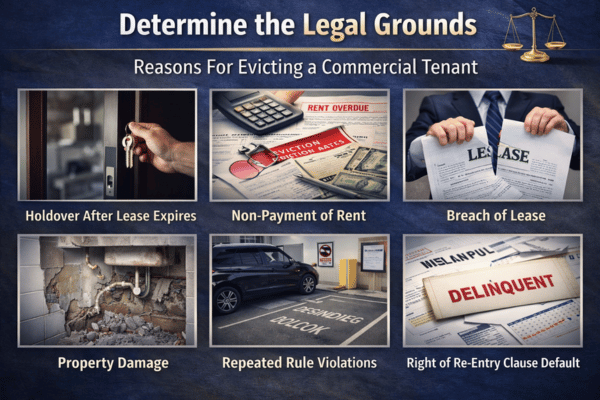
Reasons For Evicting a Commercial Tenant
The steps to evict a commercial tenant begin with determining whether the facts, lease, and law support the case. You can evict a commercial tenant in New Jersey for the following reasons:
- Holdover after the lease expires: (i.e., the lease ended last month and the tenant still won’t turn over keys).
- Non-payment of rent / additional rent: (i.e., the tenant stopped paying base rent or refuses CAM charges and taxes labeled “additional rent”).
- Breach of lease provisions: (i.e., the tenant’s business use violates the permitted-use clause or the tenant let required insurance lapse).
- Property damage or disorderly conduct: (i.e., the tenant damaged the space or is violating noise requirements and disrupting other tenants).
- Repeated rule violations: (i.e., the tenant repeatedly violates written building rules like parking, trash disposal, or after-hours access).
- Right of re-entry clause defaults: (i.e., the lease allows termination for an uncured default and the tenant ignores the cure deadline).
Evicting a Commercial Tenant For Non-Payment of Rent
Nonpayment cases often move faster than other defaults. Landlords, unless the lease specifies otherwise, do not need to serve a notice prior to filing the eviction complaint.
Be aware that a summary dispossess case is for tenant removal only (not a rent collection lawsuit). not to function as a rent-collection lawsuit. See NJ Courts Guidance (“The judgment of possession does not entitle the landlord to the outstanding rent. To seek back rent, the landlord must file a claim in the special civil part or small claims section to collect the outstanding rent.”)
Step 2: Commercial Eviction Tenant Notices
Notices Requirements
Notice requirements in New Jersey commercial evictions depend on why you are removing the tenant and the lease provisions.
Begin by reviewing the lease. Commercial leases may require a written default notice, a cure period, and specific delivery methods (address, email, certified mail, etc.).
If the lease is silent, N.J.S.A 2A:18-53 sets forth the following requirements:
- Holdover after Lease Expiration. The law requires “demand made and written notice given … for delivery of possession” before filing for removal of a commercial tenant. This notice “shall be served either personally” or by leaving a copy at the tenant’s usual abode with a family member “above the age of 14 years.”
- Lease-Violation / Misconduct: For disorderly conduct, willful damage, repeated written-rule violations, or a breach where a right of re-entry is reserved, the statute requires “a written notice of the termination” and a demand that the tenant remove “within three days” from service. The notice “shall specify the cause of the termination of the tenancy.”
- Nonpayment of rent: Unless the lease states otherwise, commercial landlords may file for eviction for nonpayment of rent without statutory notice to quit.
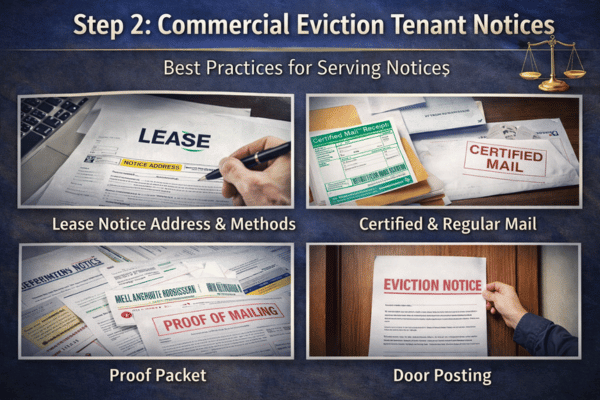
Best Practices for Serving Notices
Serving notices is where commercial eviction cases often get delayed, even when the landlord is right. The goal is simple: follow the lease exactly and build a clean record.
Best practices that reduce motion practice later:
- Use Lease Notice Address and Methods. Use the lease’s notice method and notice address (mail, email, or service on an agent). If the tenant has a new address, send a copy there too.
- Certified and Regular Mail. Send the notice by certified and regular mail (or certified + overnight courier) when the lease permits. Multiple delivery methods prevent a tenant from denying receipt of the notice.
- Proof Packet. Keep a complete proof packet, including a copy of the notice, mailing receipts, tracking, and any delivery confirmations.
- Door Posting. If posting is used, document it with clear photos. Make sure the images show the notice on the door and the full entryway.
Step 3: File the Complaint for Possession
Complaint Filing Process
Commercial eviction cases are filed in the Superior Court’s Special Civil Part (Landlord-Tenant) in the county where the property is located. Filing costs as of March 2026 include $50 for one defendant, $5 for each additional defendant, plus a $7 service fee.
Self-represented landlords can submit documents through the Judiciary Electronic Document Submission (JEDS) system, while attorneys file landlord-tenant documents in eCourts.
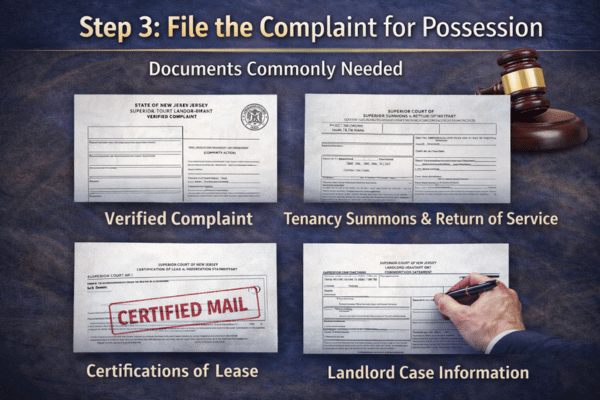
These documents commonly appear in a filing package:
- Verified Complaint. Document that starts the case and explains why you are evicting the tenant (e.g., nonpayment, holdover, lease breach).
- Tenancy Summons and Return of Service. Notifies the tenant that an eviction case has been filed and provides the court date and basic instructions.
- Landlord Case Information Statement. An administrative form that gives the court basic case details (parties, property address, type of claim, and related information).
- Certification of Lease and Registration Statement. Confirms the existence of the lease, attaches the lease, and requires registration-related information.
- Certification by Landlord. Statement confirming key facts like the tenancy, the default, amounts due (if relevant), and that required notices and attachments are included.
- Certification by Landlord’s Attorney. Statement from attorney confirming required representations about the filing and documents submitted.
Exhibits and Evidence
The exhibits and evidence the landlord needs to demonstrate to the court are to prove: (1) a valid commercial tenancy existed, and (2) the tenant defaulted on the lease or was a holdover.
Evidence may include:
- Lease and Rent Ledger. Signed lease (and amendments/renewals/guaranty/rent schedule) plus ledger showing charges, payments, credits, and the running balance.
- Billing and Payment Records. Rent invoices/statements, CAM/tax/insurance bill-backs marked as “additional rent,” late-fee/default notices, and bank/payment confirmations.
- Tenant Notices and Cure Proof. Demand letters, emails/texts about missed payments, and any bounced-check/NSF documentation.
- Dispute Defense and Witness. Any offset/abatement/repair documents (emails, change orders, approvals) and a live witness who can authenticate the records and explain what was due, paid, and outstanding.
Requirement to Use an Attorney
In New Jersey landlord-tenant court, business entities (LLCs, corporations, etc.) must be represented by an attorney. The courts do not allow a non-lawyer owner, manager, or employee to “stand in” for the company. See New Jersey Court Rule 1:21-1(c) (“an entity . . . shall neither appear nor file any paper . . . except through an attorney.”)
Is your commercial property held by an entity? Our firm will serve the correct notices, file the complaint package, and move the matter towards a judgment for possession and warrant of removal.
Call (201) 627-2457 or visit our Contact Us page to begin.
Step 4: Service of Complaint on Tenant
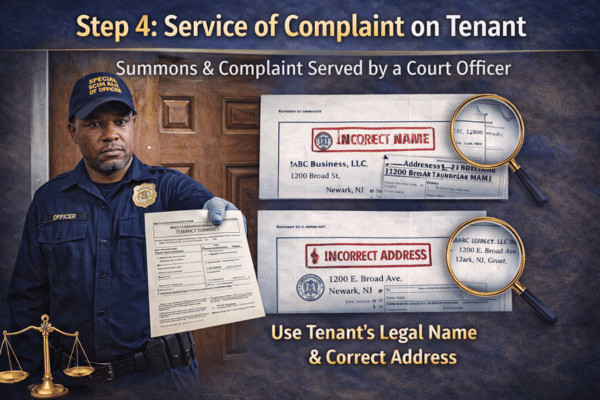
Tenants must receive the summons and complaint in accordance with court rules. Deficient service can trigger adjournment or dismissal of the case, requiring you to start over.
In many landlord-tenant cases, the court arranges service through a Special Civil Part Officer, and there is typically a separate service fee in addition to the filing fee.
Ensure proper naming and identification is a service issue. Use the tenant’s exact name from the lease (and confirm it against reliable records when possible). Incorrect spelling/address creates an argument for defective service.
Step 5: Court Appearance
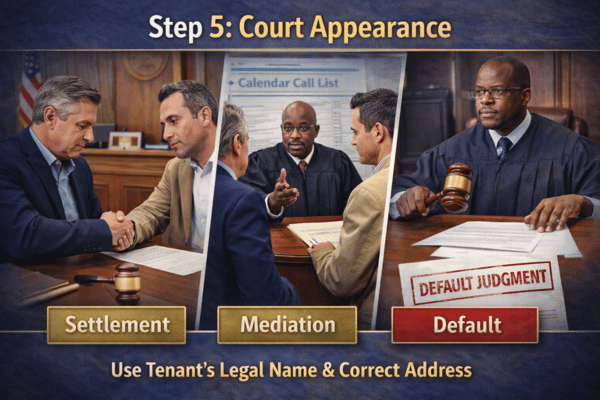
When you appear in landlord-tenant court, expect a calendar call rather than an immediate trial. The judge or court staff will call the cases, confirm appearances, and often direct the parties to discuss settlement or mediation.
Settlement/Mediation
Settlement and mediation are ways to resolve an eviction case without a trial. They typically occur either before or after the calendar call on the same day as the hearing.
Settlement means the landlord and tenant voluntarily agree on terms to end or continue the tenancy, usually memorialized in a written or on-the-record agreement.
Mediation is a facilitated negotiation, typically conducted by a court-appointed mediator or judge, where a neutral third party helps both sides explore whether a resolution is possible.
If the parties reach an agreement, it is typically entered as a consent judgment or written settlement placed on the court record. These agreements often include payment plans, compliance deadlines, or “pay and stay” terms that allow the tenant to remain so long as conditions are met. The case proceeds to trial if no agreement is reached.
Default
Tenants who fail to appear often are marked for default.
Default means the court treats the tenant as having failed to contest the eviction, allowing the landlord to proceed without the tenant’s testimony. The judge may review the landlord’s proofs and, if satisfied, enter a default judgment for possession in favor of the landlord.
A default is not always the end of the matter. Tenants can file a motion to vacate the default by claiming improper notice – particularly relevant in Section 8 cases with enhanced notice requirements.
Trial: Summary Proceeding
The case proceeds to trial if mediation/settlement is not successful.
Trials in New Jersey landlord-tenant court are “summary proceedings”. A summary proceeding is fast and limited in scope. There is no jury or discovery, and the court only decides whether the tenant should be removed.
The judge will hear brief testimony from the landlord (or property manager) and the tenant, review documents, and issue a decision. Landlords must prove to succeed in a trial:
- legal grounds for removal of the tenant;
- correct notices were served,
- compliance with Section 8 requirements.
Step 6: Judgment For Possession
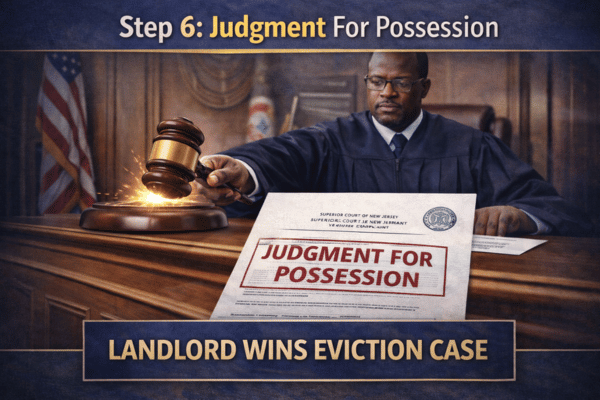
A judgment of possession is the judge’s ruling that the landlord has proven the case for eviction. The judgment of possession allows the eviction to move forward to the final enforcement stage.
The judgment of possession is usually entered at the end of a successful trial, by default if the tenant fails to appear, or as part of a consent judgment following settlement/mediation.
Step 7: Warrant of Removal
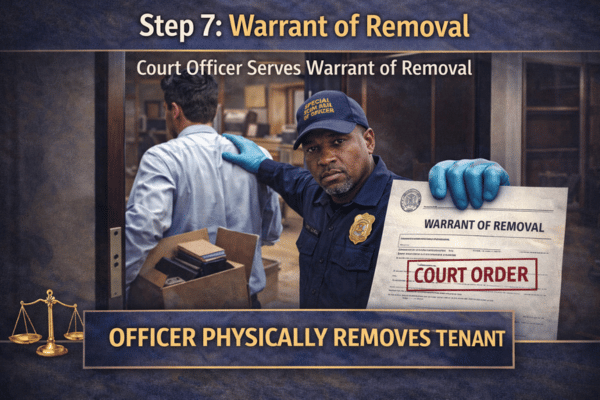
After a judgment of possession is entered, the landlord must take an additional step to enforce it by requesting a warrant of removal from the court. The warrant of removal is the document that authorizes a court officer to physically remove the tenant.
New Jersey limits when a warrant can be issued. Pursuant to N.J.S.A. 2A:18-57, the court generally waits at least three days after judgment of possession. See Commercial Warrant of Removal.
Step 8: Lock-Out
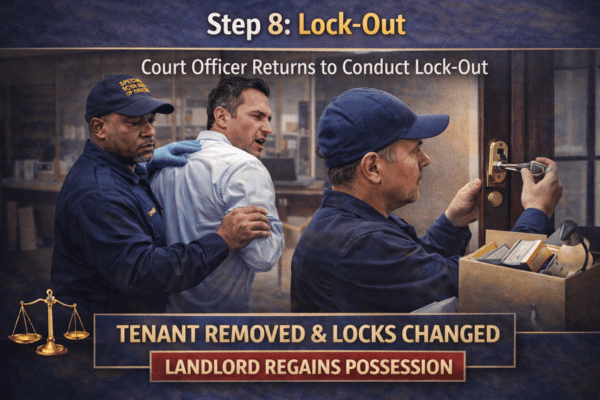
If the tenant does not vacate by the scheduled date, a Special Civil Part officer or court-appointed constable conducts the lockout. The officer will return to the property, remove the tenant if necessary, and restore possession to the landlord.
Landlords should never conduct the lockout themselves. Any attempt by a landlord to change locks, remove belongings, shut off utilities, or otherwise force the tenant out of the premises is illegal. See NJSA 2A:39-1 (“No person lawfully or peaceably entering upon or into any real property shall hold or keep the same with force; and whatever words or circumstances, conduct or actions, as will make an entry forcible under this chapter shall also make a detainer forcible.”)
The landlord does not gain ownership of the tenant’s personal property simply because the lockout occurs. Any personal belongings left behind must be handled in accordance with New Jersey’s abandoned property law.
Frequently Asked Questions
How long does it take to evict a commercial tenant?
Some cases finish in weeks, not months. The summons often sets a trial date a few weeks after service. Contested cases can take longer because courts grant adjournments and require proof. After judgment, at least three days must pass before a warrant is issued.
How hard is it to evict a commercial tenant?
It depends on how clean your paperwork is. Nonpayment cases are usually more straightforward than breach cases. Notice defects and service errors create major delays. A tenant can also slow the case with motions and adjournment requests.
Options If Tenant Stops Paying Rent
Start with a lease review and a rent ledger review. You can send a demand letter and attempt to set up a payment plan. You can also file for possession through a summary dispossess action. To recover money, you often file a separate collection lawsuit.
Options If Tenant Breaches the Lease
Document the breach with photos, emails, and inspection notes. Follow the lease default clause, including any cure period. Use a notice to cease or a termination notice when required. If the breach continues, file in the Special Civil Part for possession.
Steps to Evict a Month-to-Month Commercial Tenant
Evicting a Month-to-Month commercial tenant begins with a one‑month notice to quit. The notice must clearly end the tenancy on a specific date. If the tenant stays, the landlord files a complaint for possession. The court then schedules a hearing and may issue a warrant after judgment.
Steps to Evict a Commercial Tenant Without a Lease
A tenancy exists even without a written lease if there is a landlord-tenant relationship. The steps to eviction are comparable to those without a written lease: serve notice, file an eviction case, prepare for and attend court, obtain a judgment for possession and a warrant for removal, and then lock out.
Cost to Evict a Commercial Tenant
Costs vary by county, tenant behavior, and attorney involvement. Court filing fees and service fees apply at the start of the case. You may also pay officer fees for a warrant and locksmith charges for the lockout. Attorney fees can become the largest expense, especially in contested matters.
Does a landlord need an attorney to evict a commercial tenant?
Eviction actions require an attorney if the landlord is an LLC, corporation, or partnership. Sole proprietors can sometimes appear without counsel. Legal help often prevents costly mistakes. Legal fees can be far less than months of lost rent.
Common Tenant Defenses to Commercial Eviction
Tenants often argue that the notice or service was improper. They may dispute the rent amount, offsets, or what counts as “additional rent.” They may claim the landlord breached first or waived the default. They may also raise factual disputes that force a hearing.
Contact the Law Firm of Earl P. White
Contact us today for help with the process of evicting a commercial tenant or serving a notice to quit. Regain control of your premises. Protect your investment. Eliminate stress caused by difficult business tenants.
📞 Call Us: (201) 627-2457 💬 Send a Message: Contact Form.
Featured Content
3 Key Lease Provisions for Commercial Tenants in New Jersey
Negotiating a commercial lease in New Jersey? Learn the 3 key provisions every tenant must protect: exclusivity, renewal options, and cure periods.Do You Need an Attorney for a Deed Transfer in New Jersey?
Need a deed transfer in New Jersey? Learn if you need a real estate attorney, what forms are required, and how to avoid costly legal mistakes.