
Commercial tenants across New Jersey negotiate leases in a market where landlords often have the upper hand. Whether you are opening a smoothie and juice bar in a strip mall, launching a retail store, or expanding a service-based franchise like a UPS Store, lease terms make or break your business.
Commercial leases are not standardized. They are heavily negotiated and often drafted in favor of the landlord.
- Tenants need to be strategic.
- You can’t fight every clause.
- You have to pick your battles.
The blog will cover three commercial lease provisions that tenants should focus on.

1. Exclusivity: Protecting Your Market Share
One of the most important provisions a tenant should push for is an exclusivity clause.
What Is an Exclusivity Clause?
An exclusivity clause prevents the landlord from leasing space to a competitor of your business.
For example, if you’re opening a smoothie and blended juice shop in a strip mall, your business will be harmed if the landlord leasing the unit next door to another smoothie bar offering comparable products. Similarly, if you operate a UPS Store, you would not want a FedEx, Kinko’s, or another mailing and copying center opening in the same plaza.
An exclusivity clause prohibits that from happening.
Why It Matters
Commercial tenants invest substantial capital into:
- Build-outs and tenant improvements
- Equipment and inventory
- Marketing and branding
- Staffing and operations
Your revenue can decrease if a direct competitor opens a business next door. Foot traffic expected to be captured by your store may suddenly be split. The damage can be devastatig especially for new businesses operating on tight margins.
Exclusivity protects the goodwill and customer base you are working hard to build.
How Exclusivity Is Structured
Exclusivity clauses can vary in scope:
- Shopping center exclusivity – The landlord cannot lease any other space in that specific center to a competing business.
- Portfolio exclusivity – The restriction may apply to other nearby properties owned by the same landlord.
- Geographic radius restriction – In rare cases, it may extend to a defined radius (e.g., within one mile).
The language must be carefully drafted.
Broad definitions can create disputes, while overly narrow definitions leave loopholes. For example, if your exclusivity only prohibits “smoothie shops,” could the landlord lease to a “health café” that sells smoothies? Precision in defining “competing use” is critical.
Why Landlords Resist It
Landlords prefer flexibility. They want the ability to lease vacant space to the highest-paying tenant. Exclusivity limits that flexibility. That’s why tenants should be prepared to negotiate this strategically and make it one of their priority provisions.
If you’re only going to push hard on a few issues, exclusivity should often be one of them.

2. Option to Renew: Securing Your Future
The second key provision tenants should negotiate is an option to renew.
What Is an Option to Renew?
An option to renew gives the tenant the right to extend the lease term for an additional period, often without needing the landlord’s approval.
For example:
- Initial term: 3 years
- Renewal option: One additional 3-year term
At the end of the first three years, the tenant can choose whether to extend the lease.
Why It’s So Important
When you sign a lease for a new business, there’s uncertainty.
- Will the business thrive?
- Will the location perform as expected?
- Will customer traffic meet projections?
An option to renew creates flexibility.
You can exit the business at the end of the initial term if it faces difficulties. On the other hand, if it thrives, securing the location you have invested in is essential.
Successful businesses often depend on location consistency. Moving can mean:
- Losing loyal customers
- Incurring new build-out costs
- Facing downtime during relocation
- Rebuilding brand awareness
Without an option to renew, you’re at the mercy of the landlord. They could:
- Refuse to renew,
- Increase rent dramatically,
- Or demand renegotiation of the entire lease.
An option to renew removes that uncertainty.
Structuring the Renewal
Leases typically include provisions to make renewals fair and predictable, such as:
- Pre-set rent increases (e.g., 3% annually)
- Fair market value formulas
- Larger rental bump at the start of the renewal term
You can avoid future negotiations and disputes by establishing the structure in advance. There’s no back-and-forth. You simply exercise your option in writing within the required timeframe.
This predictability is invaluable for business planning, financing, and long-term growth.
A Strategic Sweet Spot
Many tenants negotiate:
- A shorter initial term (e.g., 3 years)
- With one or two renewal options
This structure balances risk and opportunity. It protects you if the business fails, but rewards you if it succeeds.
3. Cure Periods: Protecting Against Harsh Enforcement
The third critical provision tenants must focus on is the cure period.
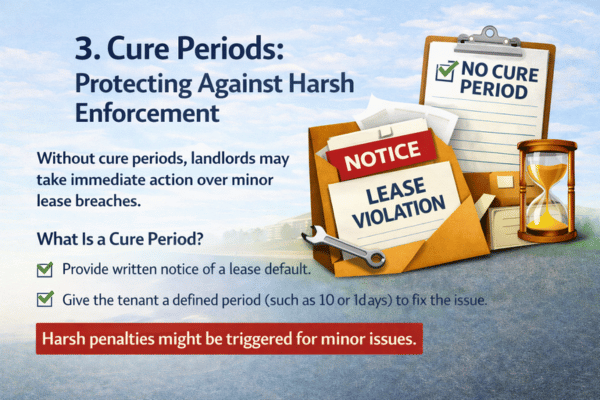
What Is a Cure Period?
A cure period requires the landlord to:
- Provide written notice of a lease default, and
- Give the tenant a defined period (such as 10 or 14 days) to fix the issue before enforcing remedies.
Without a cure period, landlords may have the right to take immediate action upon default.
Why This Matters
Commercial leases often include strong enforcement language favoring the landlord. If a tenant breaches the lease, even in minor ways, the landlord may have the right to:
- Terminate the lease
- Reenter the premises
- Accelerate rent
- Pursue legal action
Now consider how easily minor breaches can occur:
- Rent paid one day late
- Insurance certificate was not updated on time
- Minor repair delay
- Administrative oversight
Without a cure period, these small mistakes could technically trigger serious consequences.
How Cure Periods Protect You
A cure period creates a buffer.
Instead of immediate penalties, you receive a written notice and an opportunity to correct the issue. This keeps your business running and prevents disruptions over minor technical defaults.
Typical cure periods may include:
- 5–10 days for monetary defaults (like unpaid rent)
- 10–30 days for non-monetary defaults (like paperwork or maintenance issues)
In some cases, leases allow for additional time if the cure cannot reasonably be completed within the initial period, provided the tenant is diligently working to resolve it.
Negotiation Considerations
Landlords often try to limit cure rights (especially for repeated late payments). Tenants should ensure:
- Notice must be in writing.
- The cure period is clearly defined.
- There are no vague “immediate termination” provisions.
This is not about avoiding responsibility. It’s about protecting your business from severe consequences triggered by small, correctable errors.
Final Thoughts: Pick Your Battles Wisely
In New Jersey commercial lease negotiations, landlords often start from a position of strength. The lease is typically drafted by their attorney and structured to protect their interests.
That’s why tenants need to prioritize.
While there are dozens of provisions worth reviewing—personal guarantees, CAM charges, assignment rights, build-out obligations—these three are often among the most impactful:
- Exclusivity protects your revenue and market share.
- Option to renew protects your long-term success and stability.
- Cure periods protect your business from harsh enforcement actions.
A well-negotiated lease doesn’t eliminate risk—but it manages it intelligently.
If you are opening a new business, expanding to another location, or renegotiating an existing lease in New Jersey, having experienced counsel can make a significant difference in protecting your investment and positioning your business for long-term success.
Need help with a commercial lease? We can assist with drafting, reviewing, and negotiating lease terms that protect your investment and reduce risk. Call (201) 627-2457 or visit our Contact Us page to get started.
Featured Content
Utility and Insurance Responsibilities in New Jersey Lease
Learn who pays for utilities and insurance in NJ rental properties, plus tips on maximizing cash flow and capital gains in single-family home investments.Mastering the Notice to Cease in New Jersey
Explore New Jersey property management essentials with our blog on the “Notice to Cease,” a key legal tool for addressing lease violations.Structuring Residential Lease Renewal Provisions: A Guide for Real Estate Professionals
Explore essential tips for structuring lease renewals in New Jersey to ensure legal compliance and streamline your real estate operations.